Traveling by Train
Traveling by train has become my passion in recent years, and I recommend everyone give it a try. I love train journeys, because they are environmentally friendly and safe. Besides, train stations are usually located in city centers, making it easy to get on and off and reaching your destination quickly. Trains also have fewer restrictions. For example, there are no strict limits on liquids as there are with flying. Some trains even have a cafe car, which is a nice touch and helps pass the time. Lastly, the scenery in most countries is beautiful to watch along the way.
I prefer journeys of 3–4 hours maximum during the day, and then I stop for the day. I avoid long journeys like 8–9 hours. Sleeper trains are also fine. The first time I took a sleeper train was in Thailand, and I enjoyed it. It’s not as comfortable as a hotel, but you save time by traveling while you sleep.
Seat61 is the most comprehensive resource on the internet, and I use it whenever I plan my train journeys. Open Railway Map shows all the railways in the world.
Here are some train journeys I have completed and loved. That’s why I recommend those routes to everyone:
Tunisia by Train
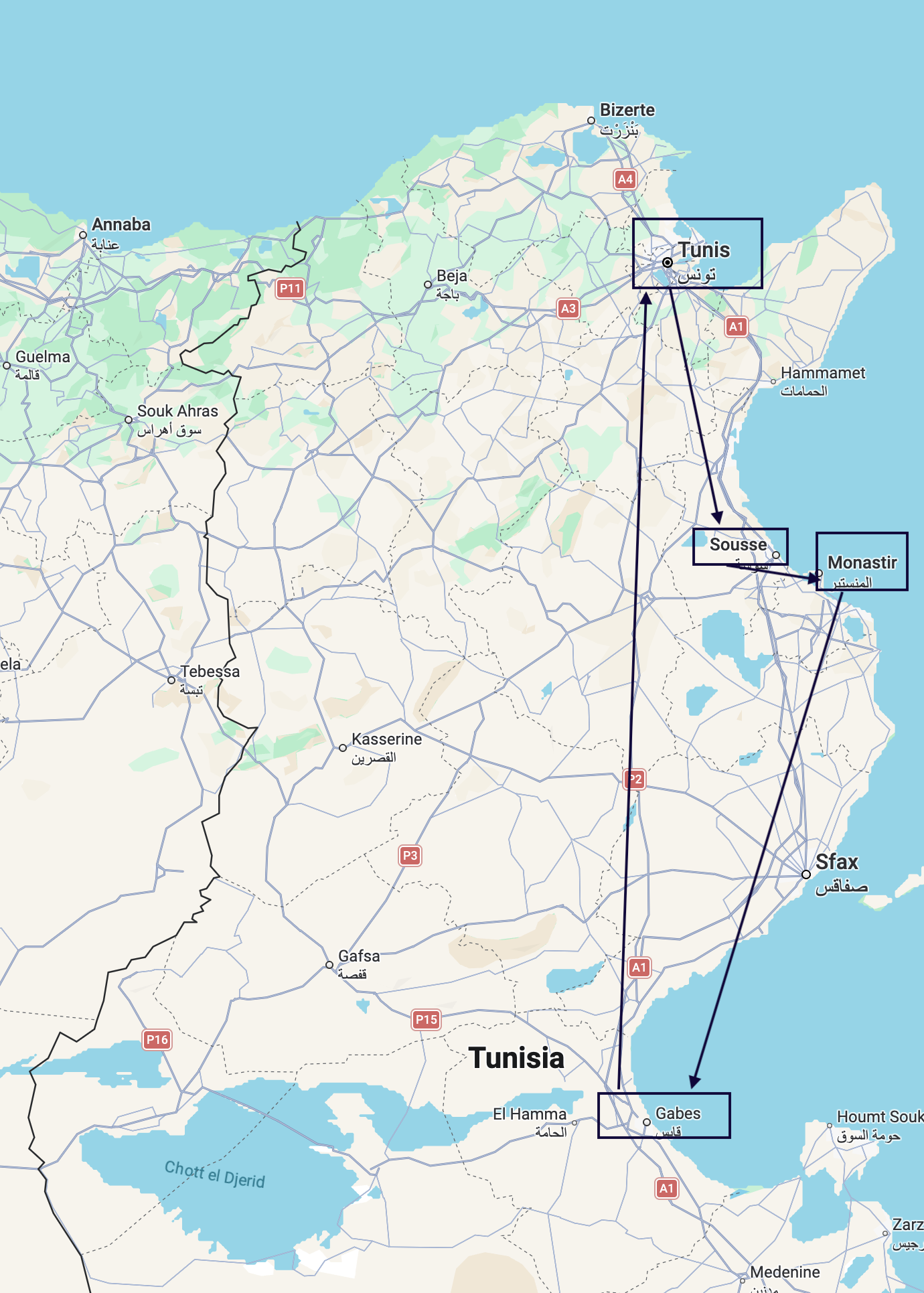
Route: Tunis -> Sousse -> Monastir -> Gabes -> return back to Tunis
Tunisia offers a one-week unlimited train travel card (also called Blue Card), which I used during my journey in the country. I traveled from the capital Tunis, to Sousse and Monastir. From there, I continued to Gabes, a city in southern Tunisia. I returned to the capital by train which took 7-8 hours. I also visited El Jem by minivan, but chose to return by train. I preferred the minivan because the train schedules weren’t convenient for the outbound journey.
Tunisian trains are old and needs improvement. Nevertheless, they are usually punctual, though they may occasionally arrive at their destination with slight delays or make unscheduled stops on the way. There is no cafe car, so passengers must purchase food and drinks at the stations. The train stations are typically modest in size but they are conveniently located in city centers and usually have at least one shop inside the station.
Trains between cities are rare, often running only once or twice a day, so journeys must be planned in advance. Some trains are equipped with air conditioning, some others are not.
Indonesia by Train
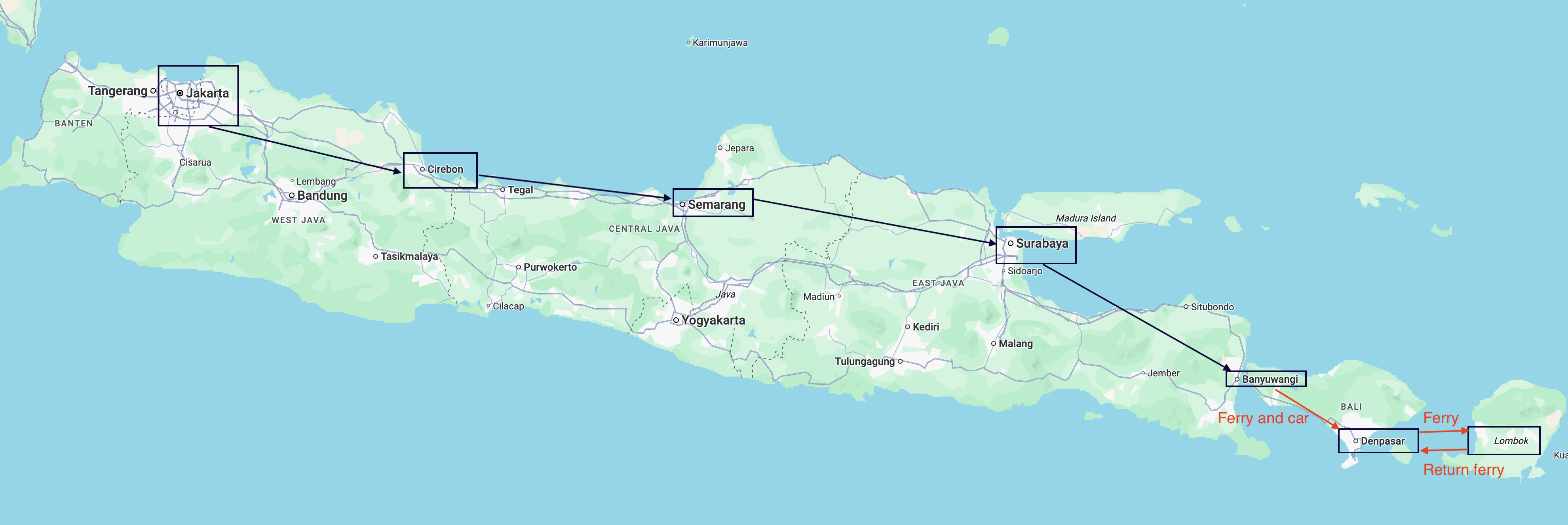
Route: Jakarta -> Cirebon -> Semarang -> Surabaya -> Banyuwangi -> Denpasar (Bali island) by ferry and car -> Mataram (Lombok island) by ferry
Java island is very convenient to travel by train. There are first, second, and third class options. Second class is good enough, while first class offers more space. Luggage areas and café cars are available on inter-city trains. Drinking Indonesian coffee on an Indonesian train is a nice experience, and the Indonesian scenery is beautiful to watch. It is possible to travel from Jakarta to the eastern tip of Java entirely by train. The downside is that only Java has a sufficient railway network; other islands do not have much.
We followed the Jakarta, Cirebon, Semarang, Surabaya, and Banyuwangi route to reach the other side of the island. We stopped in Cirebon to explore during the day. We continued to Semarang and stayed there for two nights. Afterwards, we went to Surabaya and stayed there for four nights. Semarang and Surabaya are quite large cities and are worth visiting and staying in. The journey between each of these cities takes two to four hours. After Surabaya, we went to Banyuwangi and stayed there for two nights as well. It was our last stop on Java, and we continued our journey by car and ferry to reach Bali and Lombok.
Jakarta–Bandung high-speed train: Indonesia has a high-speed train called Whoosh between Jakarta and Bandung. I took that train on a separate trip to Indonesia. It operates between Halim Station in Jakarta and Tegalluar Station in Bandung. It reaches a maximum speed of 350 km/h and is the first high-speed train in the Southern Hemisphere. It takes 35 minutes to reach Tegalluar Station from Jakarta. The train cars and stations are new, and you can find everything you need in the stations.
Thailand by Train
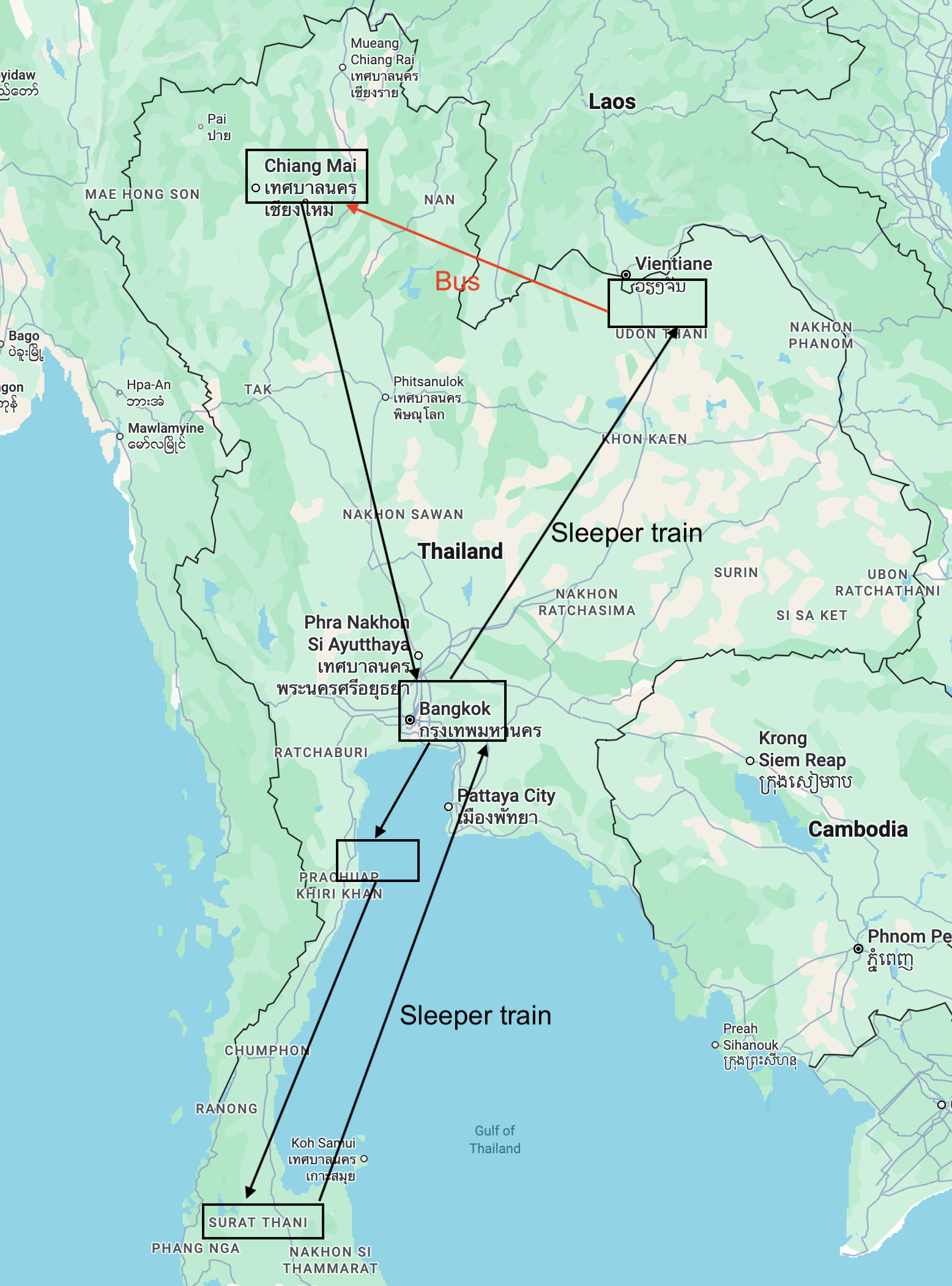
Route: Bangkok -> Nong Khai (Laos border) and stayed in Laos -> Chiang Mai by bus -> Hua Hin -> Surat Thani -> return back to Bangkok
Thailand has a decent train network. First and second class trains are good, but third class trains aren’t very comfortable and don’t have air conditioning. Sleeper trains are also available in the country. Tickets for sleeper trains must be purchased in advance for popular routes such as Bangkok–Chiang Mai.
I took a sleeper train for the first time in my life in Thailand, traveling between Bangkok and Nong Khai, on the Laos border. We had first class tickets and our own room with two beds. We bought some snacks and drinks at the station and ate them in the evening on the train, arriving in Nong Khai the next morning. Spending time on the train and sleeping there is very nice, and it helps you save time during your travels. I really enjoyed the sleeper train experience and would love to do it in other countries as well. We also took a second class sleeper train when returning from Surat Thani to Bangkok, because first class was sold out. In second class, you have your own bed. You don’t have much space, but it’s still nice and you can sleep.
We went from Bangkok to Nong Khai, visited Laos, and then came back to Thailand to continue our journey. There is no direct train between Nong Khai and Chiang Mai, so we took a bus instead. After Chiang Mai, we went to Hua Hin via Bangkok. We stayed in Hua Hin for a few days and then continued to Surat Thani. Thai train stations are conveniently located in city centers, and they have shops nearby or inside the station. The distances between big cities like Bangkok, Chiang Mai, and Nong Khai are long, and so are the journeys, so plan accordingly.